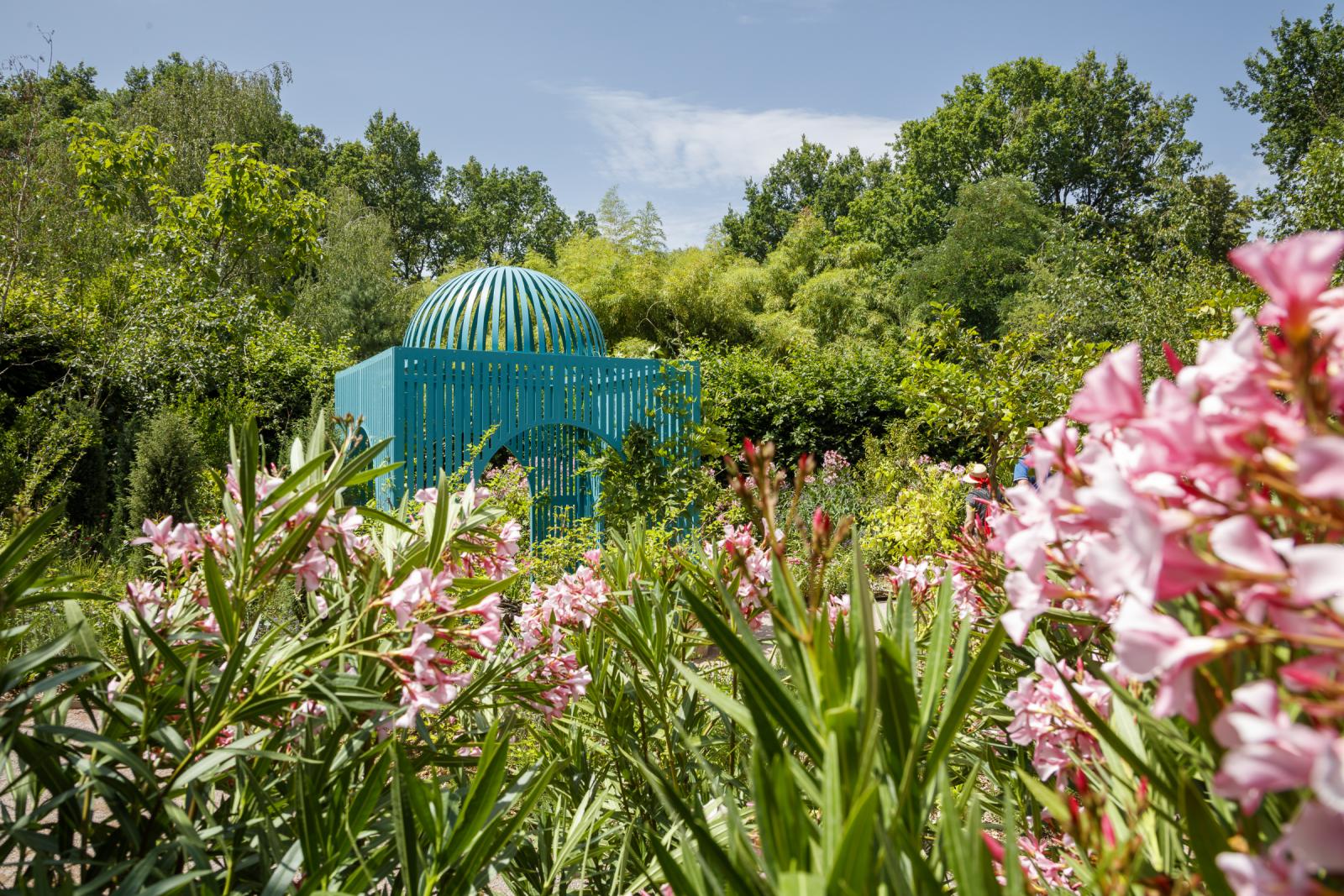
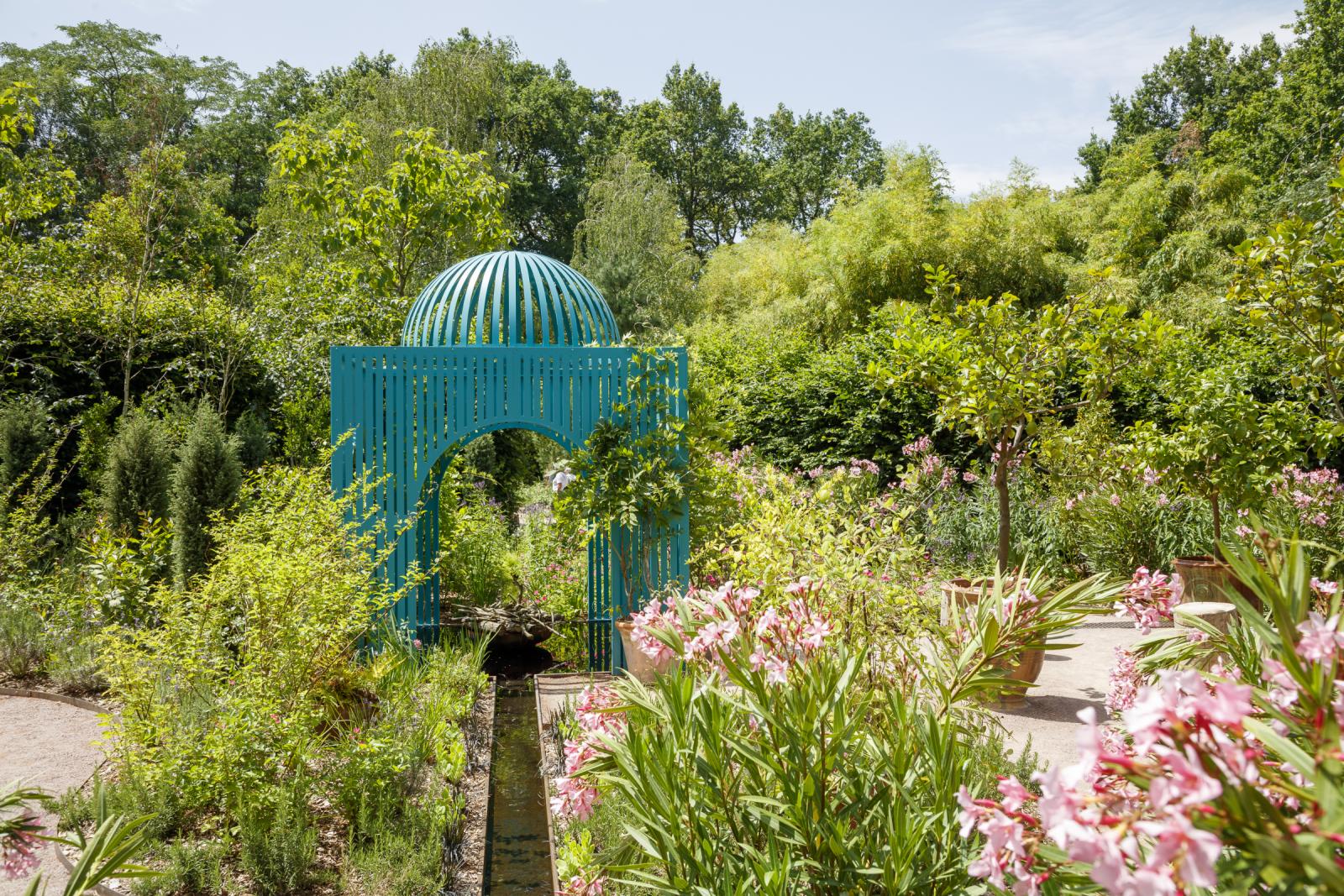
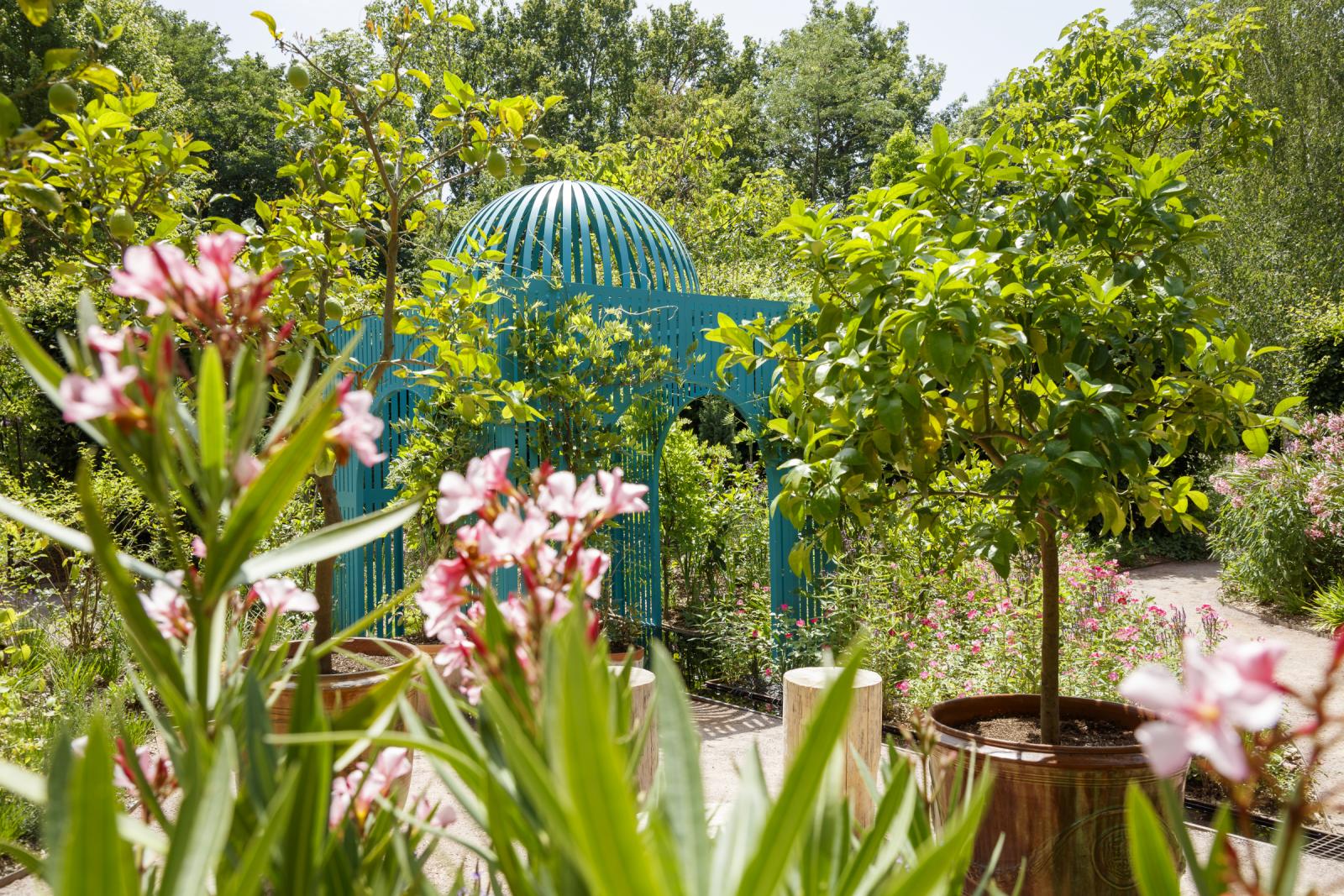
Le Jardin de Minâb is a garden dreamt and designed by the French-Iranian actress Golshifteh Farahani, whose first name means “enchanted by flowers”. It is a garden “between the waters”, an invitation to enjoy a sensory experience and escape from the rest of the world. Making use of happy, generous plants, it reconnects us with our sensations and emotions. For a few moments, it immerses us in a sanctuary that celebrates the elements – earth, air, water and fire. As we follow the water gently trickling from the four corners of the garden to the central temple, each of us is led to rediscover their inner fire. The garden acts directly on the whole being, body and soul, opening the heart to love.
Minab means ‘between the waters’ – the river and the sea...
A space humankind is ever more in need of: that in-betweenness where we can simply sit back without constantly being forced into extreme positions.
Between lands, continents, peoples and languages, between beliefs and values, between ideologies and religions, between earth and sky, between water and fire, it is here, somewhere in this in-betweenness, that life happens.
In Zoroastrian culture, most fire temples were built near a water source.
This garden is felt as an experience – an embodiment of fragrances, sounds and textures, emotions and sensations.
So leave your phones behind and step into its present moment. Listen to the birds, feel the texture of the air, the earth beneath your feet, the murmur of water and the dance of fire – the elements from which we are born.
Put aside human “doing” for a few moments and simply become a human being again.
Be there, like those white flowers. Vulnerable yet full of hope, full of life. Be here and now, in this present moment, the most precious gift life has to offer.
Be body, mind and spirit – is there a space between them or are they actually all one?
We are one.
Earth, water, fire and air.
From this encounter, an inner pathway is born. Like the poet Attar’s birds, visitors are invited to cross seven valleys, a journey that leads nowhere else but to themselves.
THE SEVEN VALLEYS
The Valley of the Quest (talab)
Certainties slip away, familiar shores recede. The garden stretches out in front of us, mysterious, still closed. We observe it listen to it, feel it calling us. Here, we learn to search, without yet knowing what we’re looking for.
The Valley of Love (eshgh)
The garden is changing. Between water and fire, opposites cease to be enemies. And we learn to love without why. We no longer look at the world, we let it pass through us. Love doesn’t possess, it permeates.
The Valley of Knowledge (marefat)
The garden opens up like a living book. The pace slows. Perhaps we sit down, perhaps we walk differently. We understand without thinking. The garden cannot be explained, it is lived.
The Valley of Detachment (esteghna)
The garden is gradually fading away. Shapes become blurred, contours disappear, and history, beliefs and identities are left behind. There’s no longer any need to be this or that. There’s no longer any need to hold onto the garden. Just being there is enough.
The Valley of Unity (towhid)
Something has shifted. We’re no longer walking in the garden, the garden is walking in us. Earth, water, fire and air have all become one. There’s no longer any separation. The garden and we who are crossing it are breathing together.
The Valley of Stupefaction (heyrat)
And suddenly, vertigo. The garden becomes immense, too big to understand. We stand there, amazed, bewildered. What can be seen can no longer be grasped and what touches us no longer has a name. We no longer know and perhaps that’s another form of knowledge.
The Valley of Nothingness (fana)
The garden finally disappears. Or perhaps it’s we who are crossing it that disappear into it. Like the river flowing into the sea, we merge without losing ourselves. There are no more walkers, no more paths, no more goals. The garden isn’t a place to walk through, but a path to find oneself.
Golshifteh Farahani, March 2026
DESIGNER
Golshifteh FAHARANI, actrice et musicienne
FRANCE/IRAN
© Rahi Rezvani
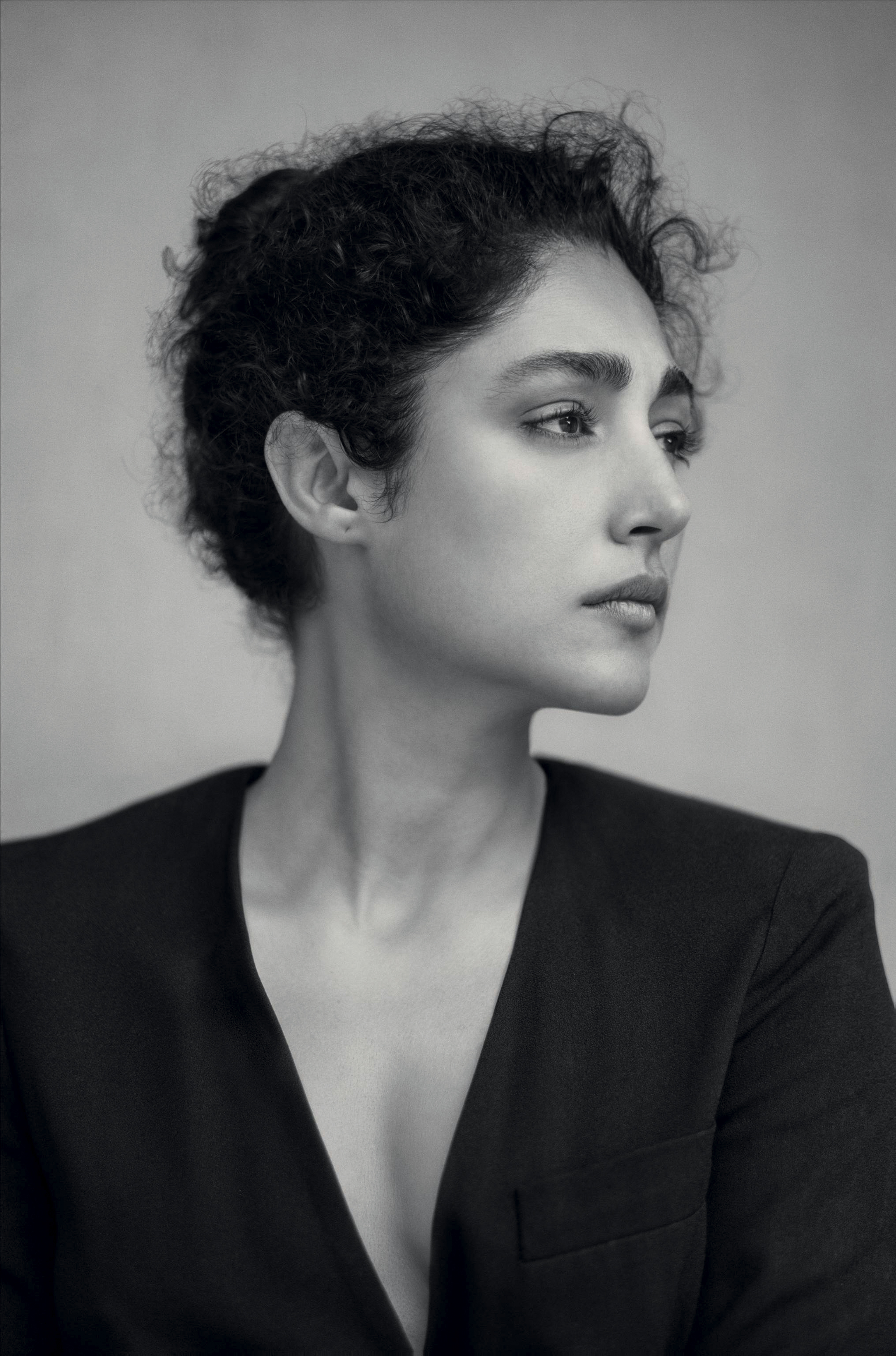
Golshifteh Farahani is born in Tehran, Iran, in 1983. The daughter of the stage director Behzad Farahani, she made a name for herself in Iranian cinema at a very early age, starting with Dariush Mehrjui’s The Pear Tree in 1998. In 2008, she rose to international fame when she starred alongside Leonardo DiCaprio in Ridley Scott’s Body of Lies. Following tensions with the Iranian authorities, she went into exile in France to continue her career. She has worked with such directors as Louis Garrel, Christophe Honoré and Arnaud Desplechin, and starred in films including Atiq Rahimi’s Syngué Sabour (nominated for the César Award for Most Promising Actress in 2012) and Jim Jarmusch’s Paterson (2016). Her latest film, Alpha, was directed by Julie Ducournau in 2025.
A committed artist, she defends freedom of expression and women’s rights, and is very active musically.
A trained pianist, she has collaborated with such artists as Ibrahim Maalouf, Barbara Pravi and Bachar Mar-Khalifé, blending Persian influences, jazz and contemporary music. She has also composed for the cinema, including the soundtrack to Hiner Saleem’s film My Sweet Pepper Land (2013), in which she also plays one of the main characters.