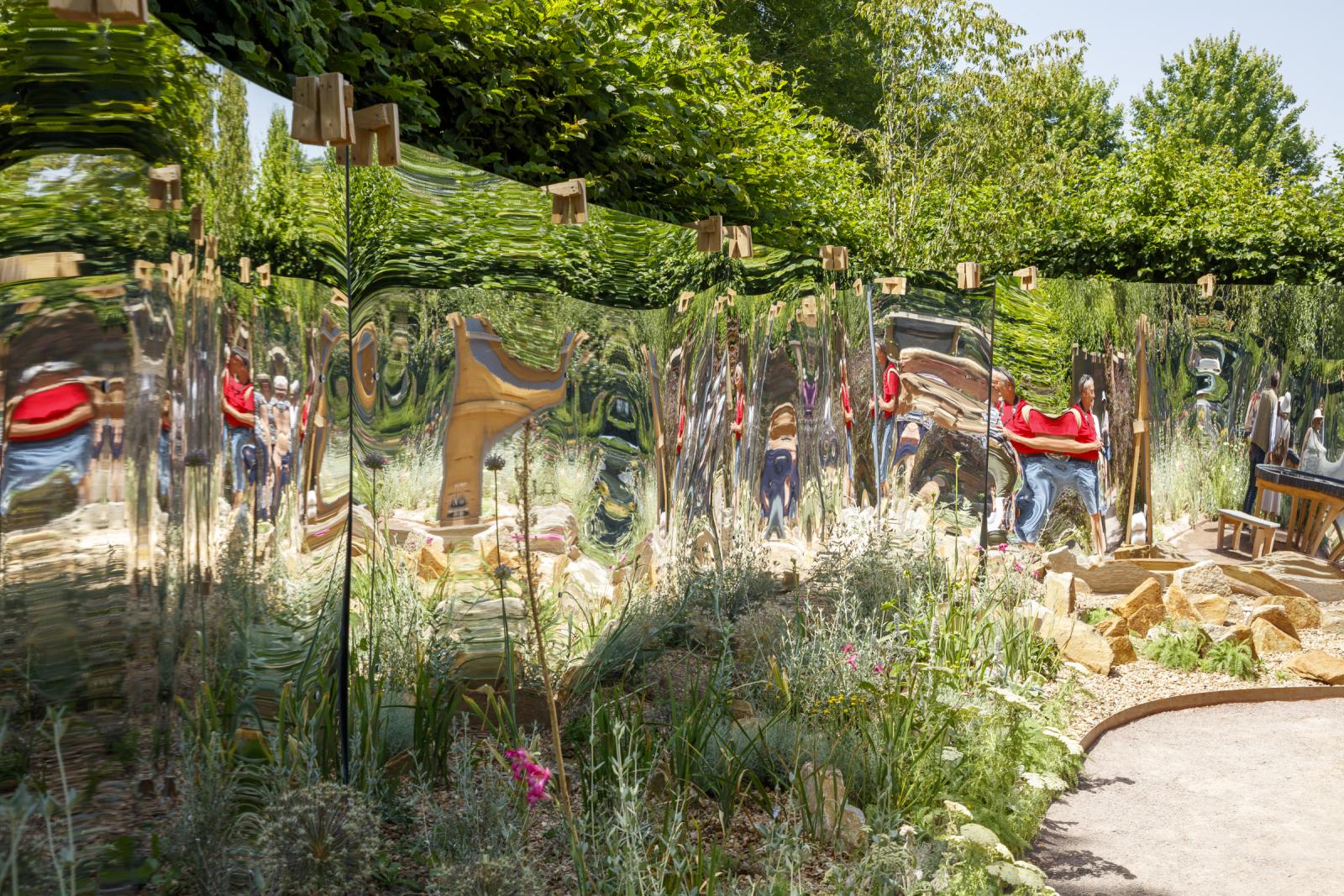
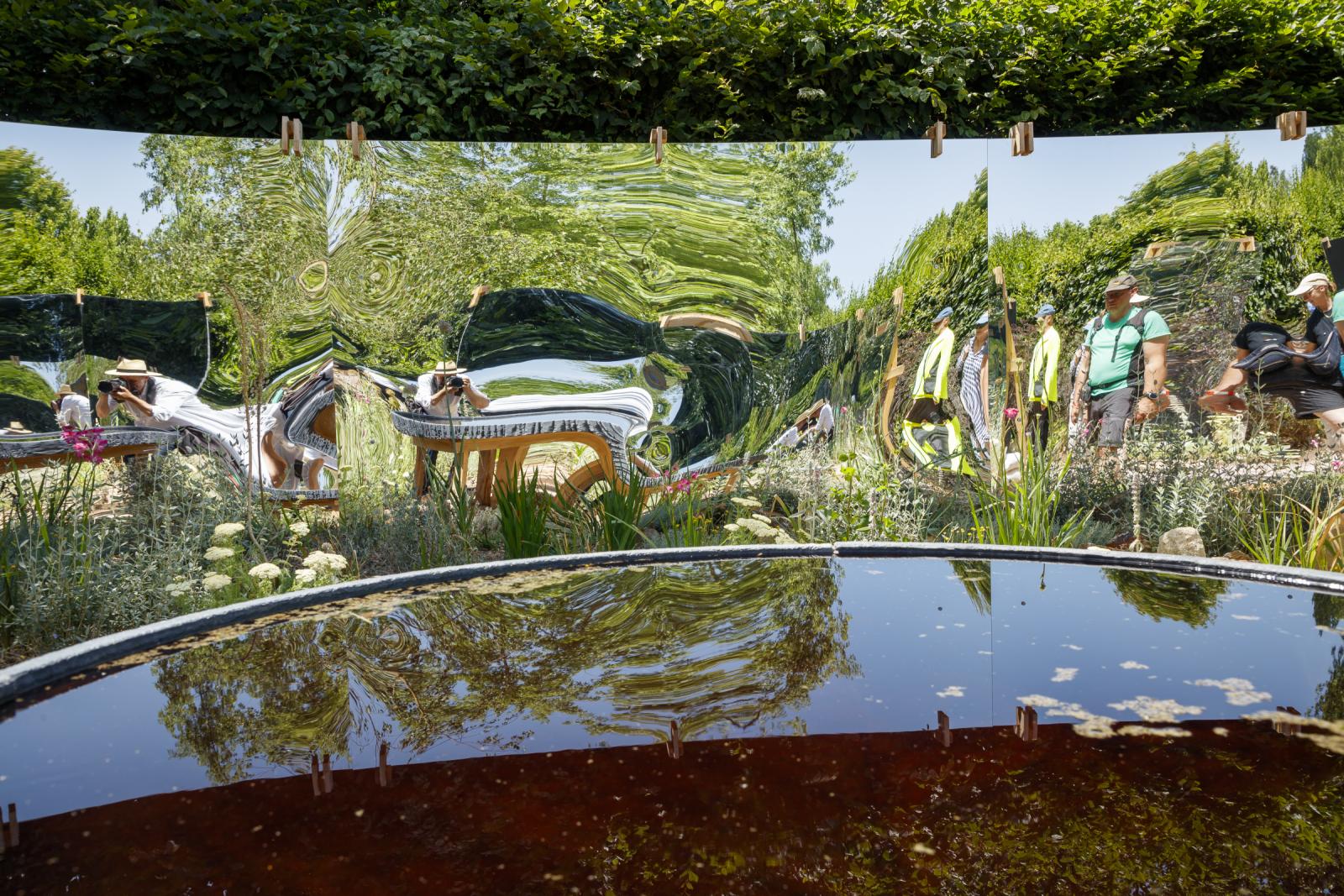
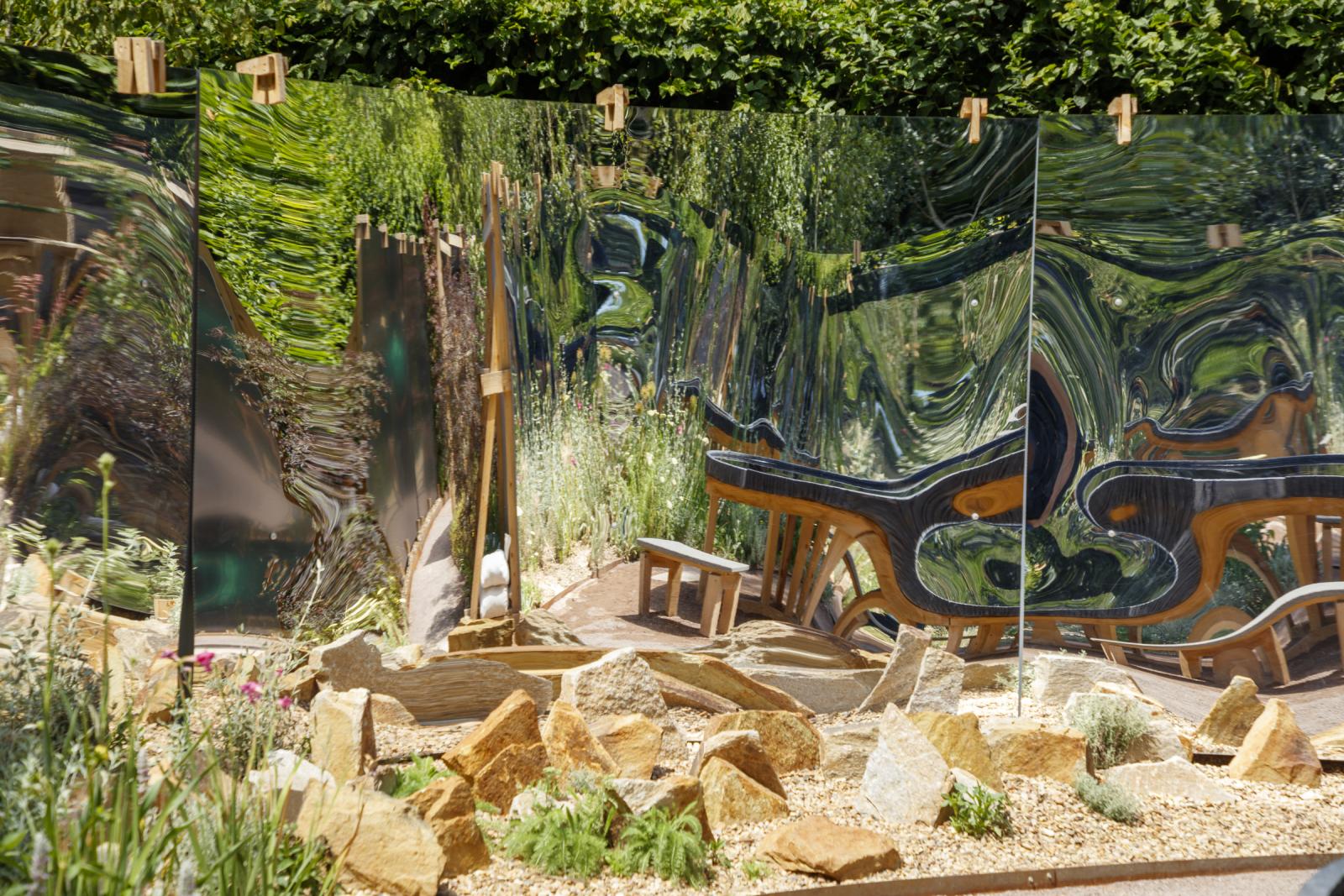
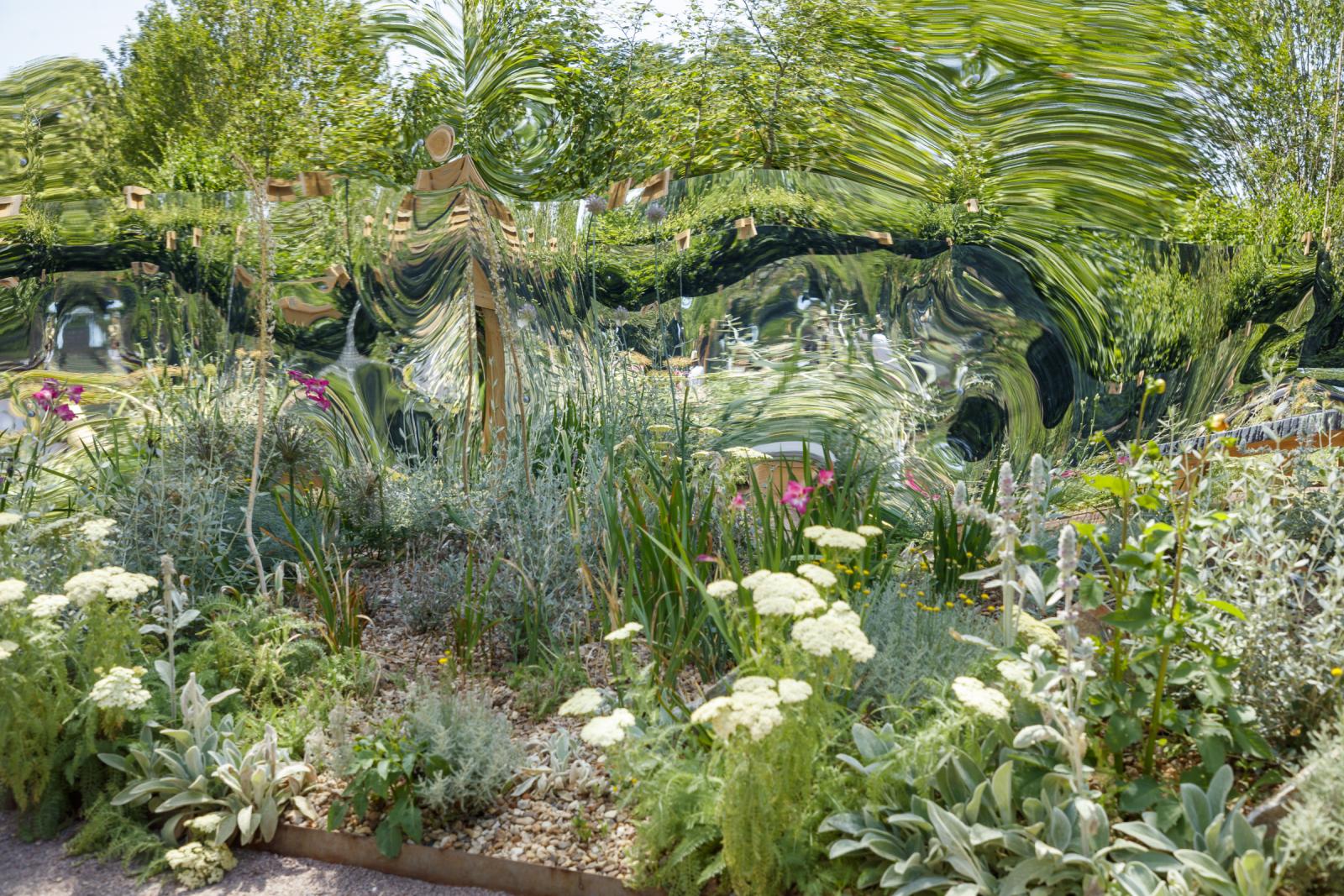
The garden unfolds like a film, scene after scene, changing, fragmenting and reconstructing perception. Inspired by Christopher Nolan’s film Inception, it invites us to step into a an entirely fabricated dream, where each space represents a level of consciousness.
As the threshold between the everyday world and make-believe, the entrance hall houses a tree with fiery red foliage, firmly rooted in reality. Two curved, slowly converging walls guide us down a corridor where the space narrows into introspection.
Cracks start to form in what is real: a large oval space, clad in reflective surfaces, casts multiple reflections, silhouettes and light fragments, while silvery hued vegetation creates a misty atmosphere. A mirror-like body of water at the centre catches the sky and movement, transforming vision into contemplation. Delicate, ever changing seasonal blossoms are dotted throughout the dream, setting the tempo like little storyline pointers.
Following on from this space is a thick, vibrant mini forest. Sequences of slender trunks, coupled with the shadows, evoke impossible architecture and disoriented perceptions. This is where the dream gets deeper, more immersive, almost tangible.
Finally, reality resurfaces: the rounded walls reappear, this time opening onto the outside world. Bright colours call out to visitors – as symbols of reawakening and a return home.
In this garden, every element – mirrors, water, wood, foliage and blossoms – make up a fluid montage, a sensory story in which the viewer becomes the main character. It is an experience that questions the boundary between the real and the imaginary, between what we see and what we dream.
DESIGNERS
Cecilia ZAMPONI and Sara FERRARO, landscape architects, Lorenzo DE FAVERI, architecture student
ITALY
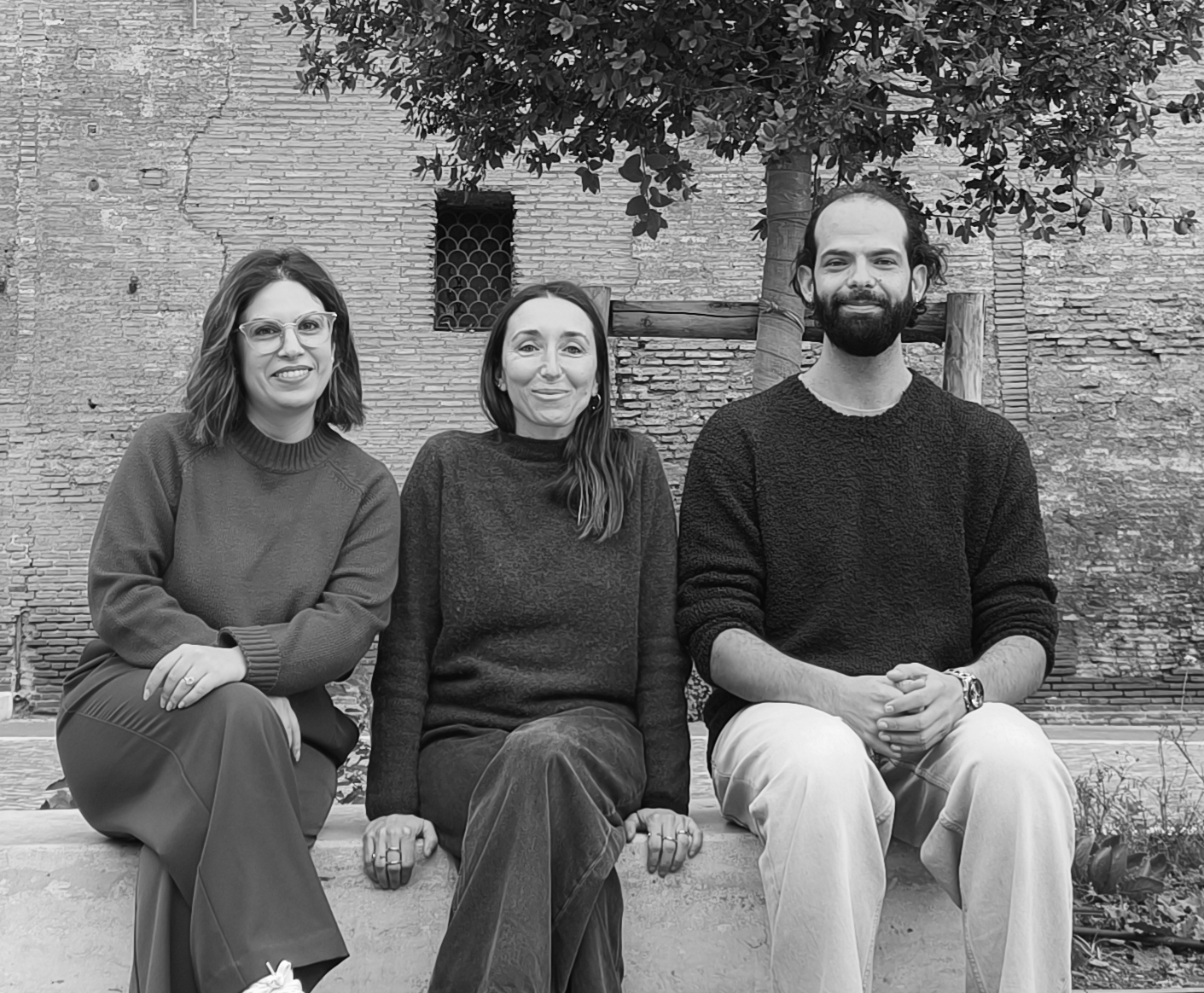
Born in Rome in 1982, Cecilia Zamponi has had a deep bond with the landscape since childhood, nurtured by a family tradition of direct experience and attention to nature's discrete forms. A landscape architect, she graduated from the Valle Giulia Faculty of Architecture at La Sapienza University in 2007. She developed specific expertise in the design of public spaces by collaborating with various firms in Rome, Paris and Lisbon, including AWP – Agence de Reconfiguration Territoriale, SESTE Engineering and F.A.R.E. Studio. In 2016, she obtained a doctorate in urban studies with a thesis devoted to the "return to the land" phenomenon and the multiple interactions between urban spaces and agricultural regions. She has worked as a freelance designer since 2016, founding Antesi, a landscape architecture firm based in Rome, in which she accompanies the technical, artistic and botanical aspects of the project management process.
Antesi:from the Greek anthesis ("flowering").In botany, the term designates a plant’s flowering period, i.e. the state of a plant with open flowers, or that of a flower,and is also used to describe the time during which a species flowers in a given location.
Her choice of name reflects her desire to develop an innovative, creative approach to landscape design at all scales. An approach based on aesthetics, understood not as outward appearance but as a sensitivity to relationships (Gregory Bateson): the ability to understand the world around us in its changes and permanences alike, to perceive – through knowledge that is at once cognitive and emotional, rational and biological – analogies and differences, consonances and dissonances. In a word: learn.
Born in Rome in 1993, Sara Ferraro spent her childhood and teenage years between countryside and forest, in close contact with nature. An architect specialising in landscape design and protection, she has six years' professional experience acquired during interventions at different scales, from design of open public spaces to enhancement of complex landscape and environmental contexts. She delved deeper into the connections between space, nature and wellbeing with a Master's degree in Healing Garden design, developing an approach attentive to landscape’s sensory, perceptive and therapeutic dimensions, with a particular interest in the role of the garden as a space for care, contemplation and relationships. In the course of her career, she collaborated on numerous landscape projects across Italy with LAND Italia Srl, participating in the planning, design and redevelopment of public spaces and infrastructures. Today, she works with Proger S.P.A., where she is involved in the design and protection of landscapes as part of complex, multidisciplinary processes, while continuing with her little Verdaria workshop, which enables her to explore finer scales through experiments conducted with other professionals. Her work combines technical expertise and design sensitivity, with an unwavering focus on sustainability, reversibility of interventions and the dialogue between contemporary project and natural context.
Born in Milan in 1996, Lorenzo de Faveri has a relationship with landscape that predates his interest in architecture. It was initially developed by an eye nourished by art, in a family setting where observation asserted itself as a project’s first act. From an early age, cinema also shaped this way of seeing, teaching him to read space as a sequence, influenced by time and relationships. A deep bond with nature and open spaces is interwoven with this vision. Over the years, walking has become a practice of knowing: crossing places, stopping, getting lost, observing changes, strolling. The body’s movement in space is then revealed as a design tool, capable of revealing the landscape’s silent structures. His training in architecture and specialisation in urban planning have led him to consider landscape as a relational space: the project not as a definitive gesture but as an act of interpretation that accompanies the site and amplifies its meanings. The garden presented at the Chaumont-sur-Loire Festival results from this attitude: thinking of the landscape as a stage and a visual device, where the eye, movement and time construct a narrative. A work process shared with the team, in which the project is not presented as a fixed image but as an experience to be explored.