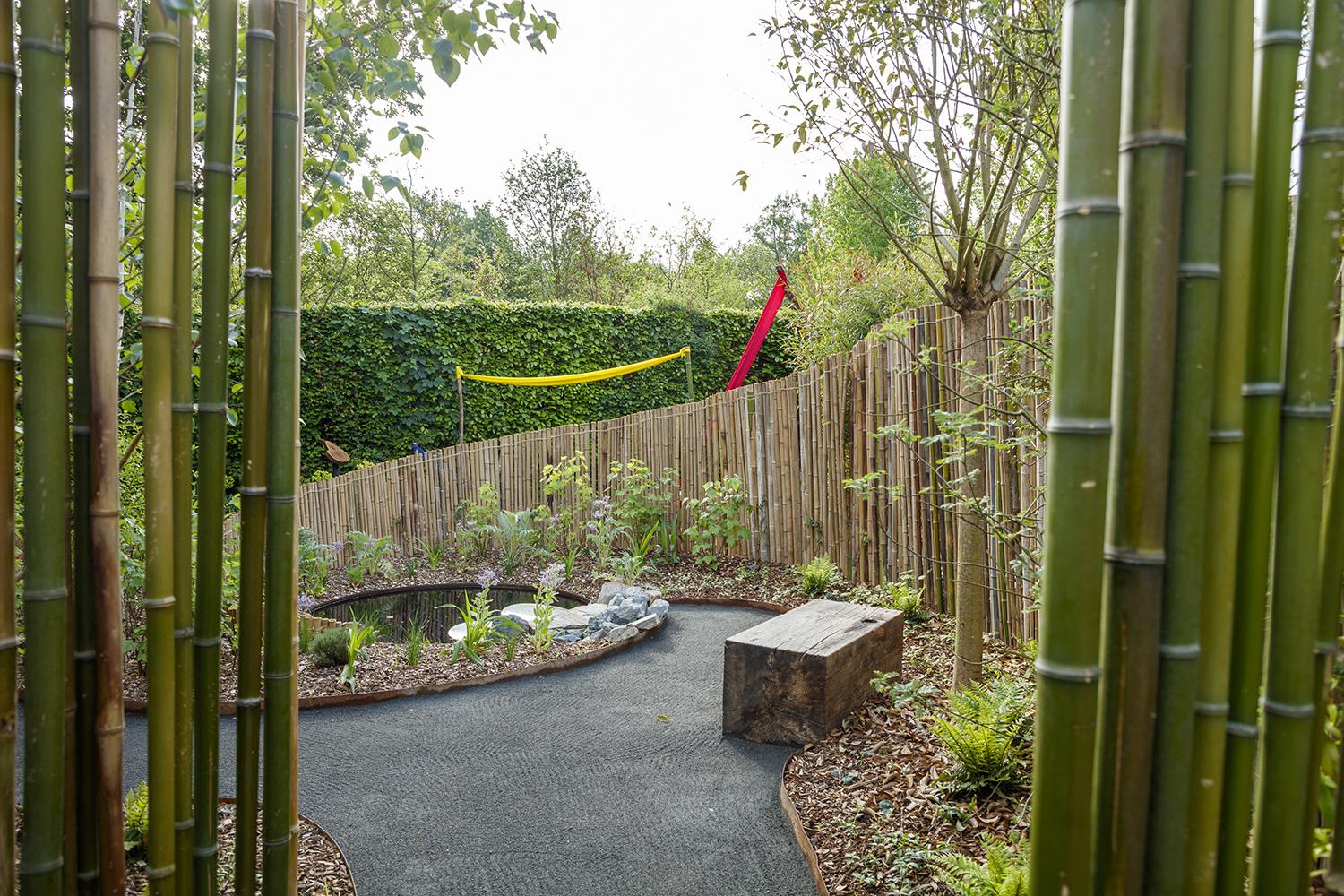
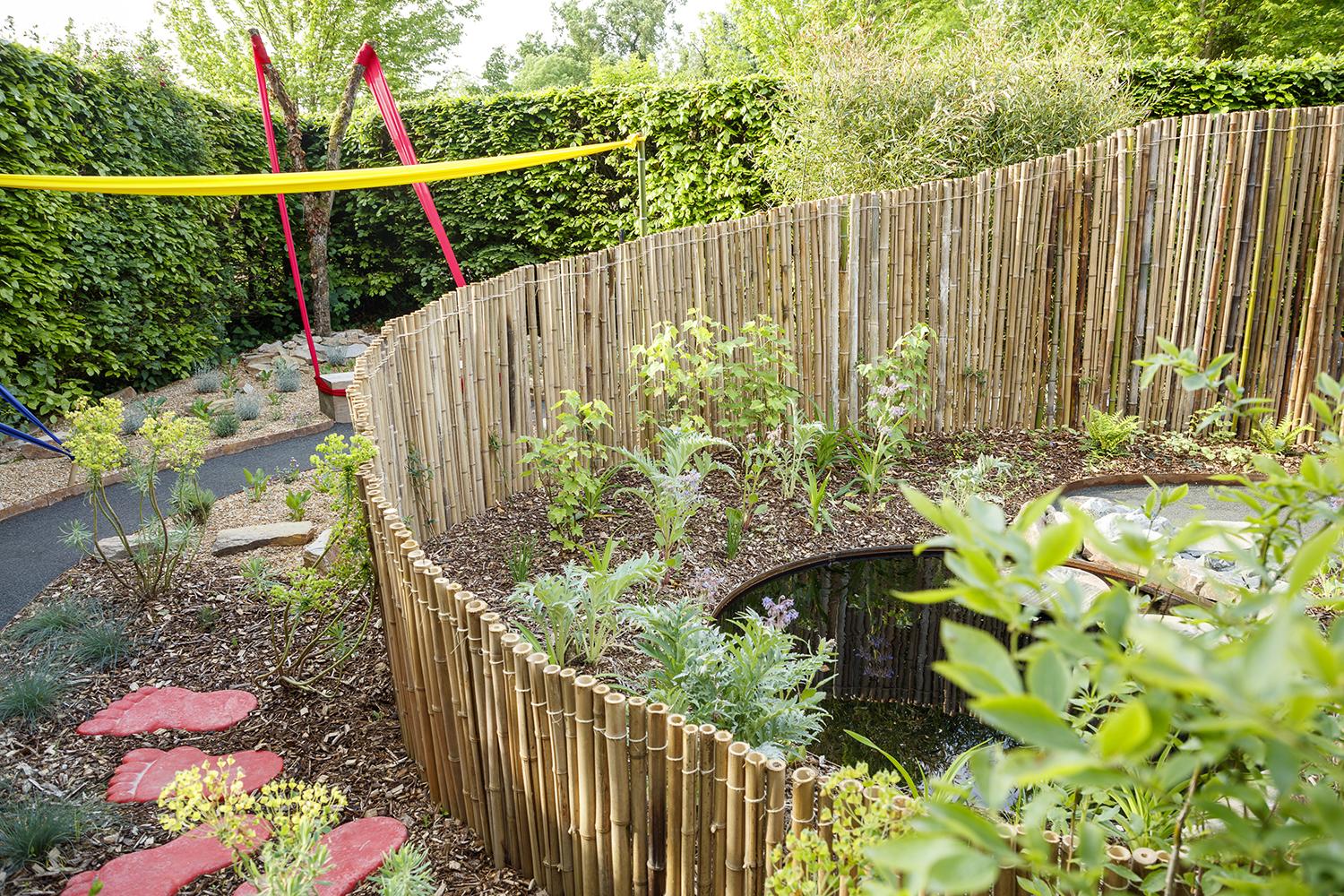
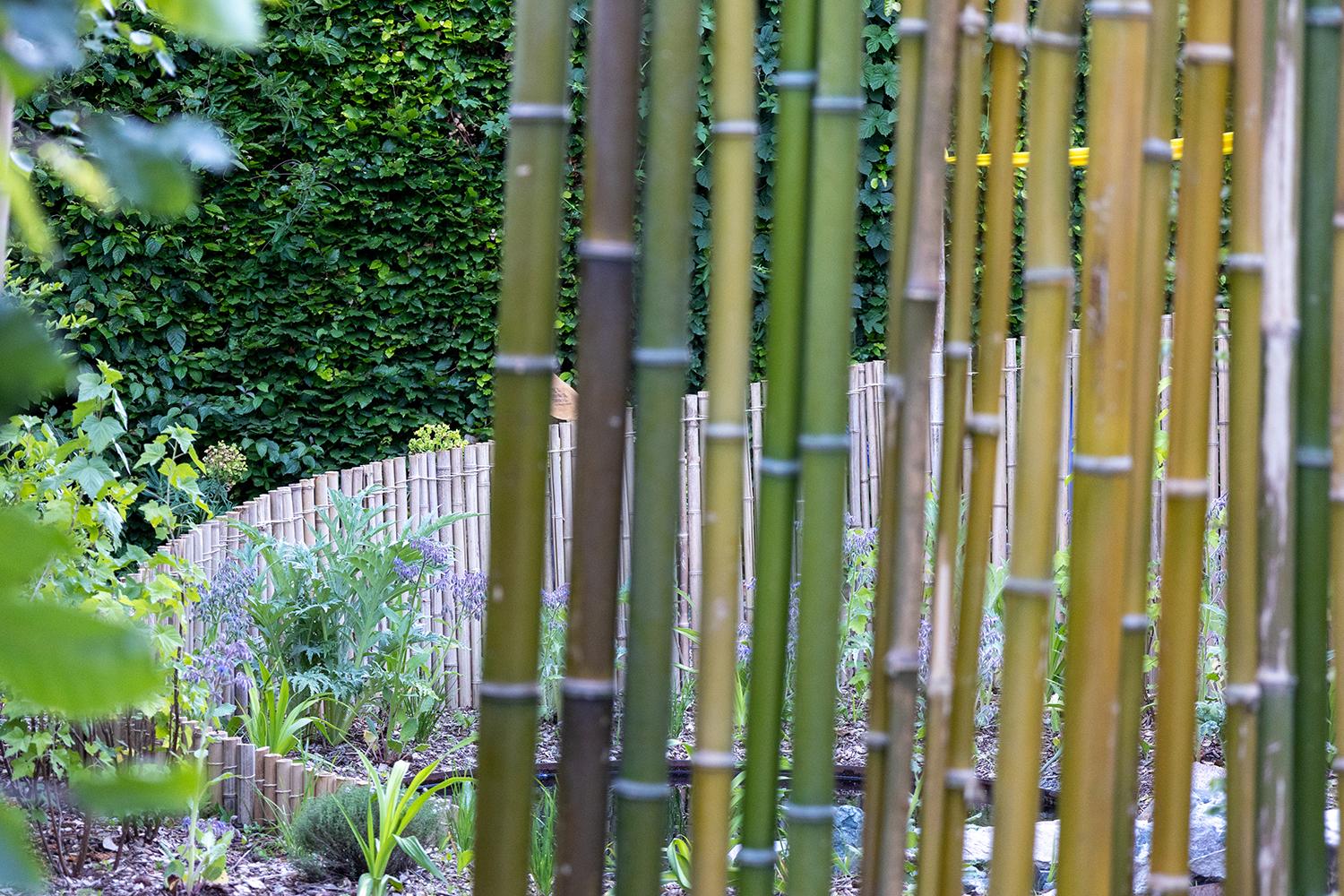
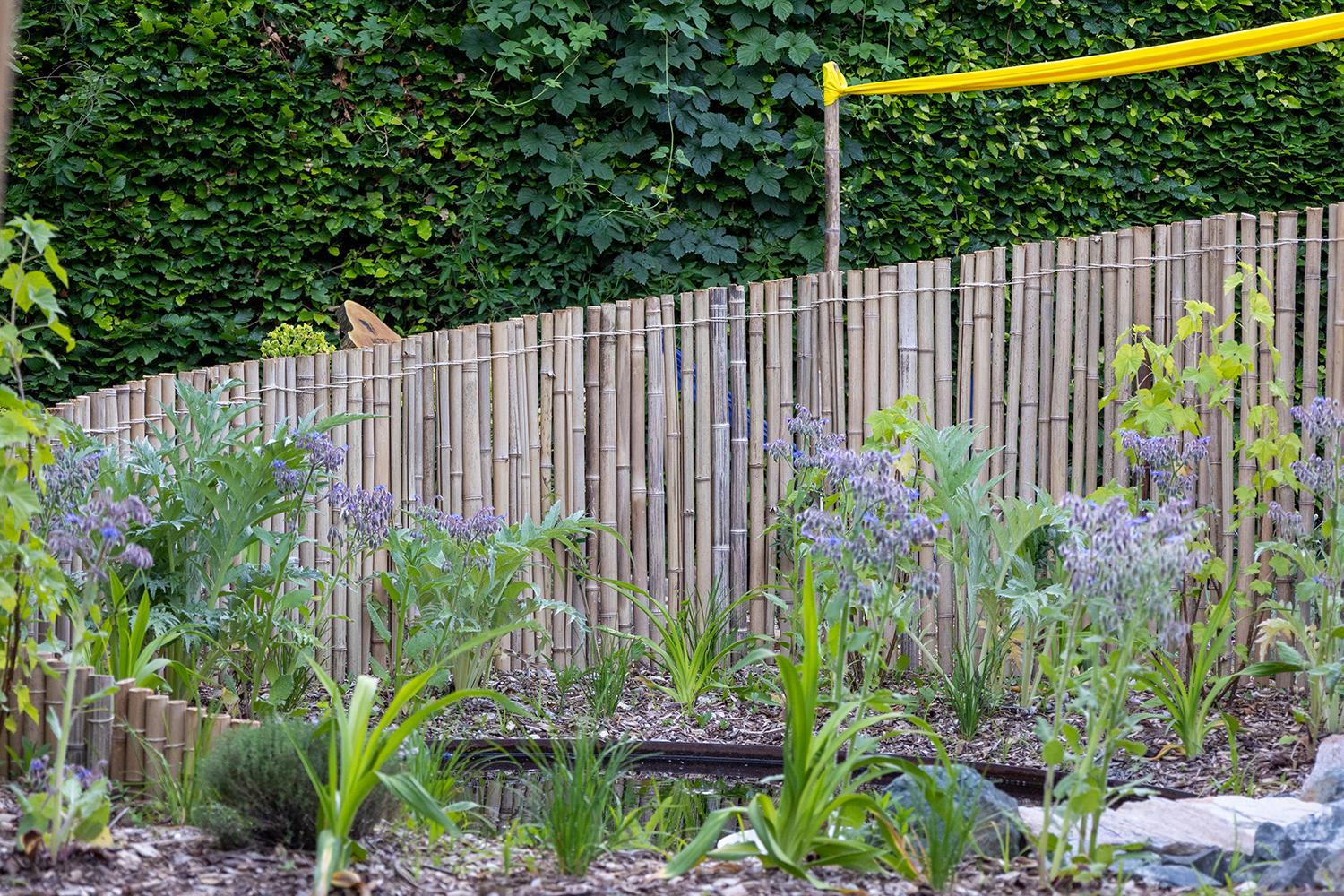
The Garden of Magical Powers showcases nature’s regeneration. Its characters, inspired by Brazilian folklore, are guardians of the forest. These elementary beings act directly on regulating human activities, guiding the behaviour of individuals who enter various natural spaces. In this garden, the vegetation is restored in five acts.
Act 1 – The opening is a burning tract, generated by a climate crisis whose roots can be traced back to the heart of humankind.
Act 2 – A purification hut provides somewhere for humans to begin a healing process, thanks to the power of aromatic species that awaken feelings of hope.
Act 3 - The process can now work its magic. Saci, a one-legged boy wearing a red hat, is the first forest guardian to be summoned. His mischievous spirit activates joy and brings about the appearance of the first plants, initiating the process of ecological succession.
Act 4 - With his feet facing backwards and prodigious physical strength, the forest guardian Curupira distracts hunters and travellers by whistling and giving misleading signals, making them lose their way. His perseverance spawns the growth of stronger, larger plants.
Act 5 - From the safe harbour of the water appears Victoria Regia, turned into a water lily. The legend goes that a young Indian woman, fascinated by the moon, drowned in the river after trying to kiss its reflection. Moved by this complete relinquishment and her love, the Moon, so it is said, turned her into a flower. What if humans, too, were to rediscover the strength of their love and reconnect with nature?
At its peak, the garden shares its resources. Humans understand that, with their cooperation, nature can recover.
DESIGNERS
Vanessa ZECHIN, Natana EITELVEN and Nichele ROSSI, landscape architects
BRAZIL

Vanessa Zechin is architect and garden designer. Graduated from UFRGS in Architecture and Urbanism (2009) - Brazil and Master's degree from Politecnico di Torino in Cultural Landscape - Italy (2012). Her relationship with nature dates back to her childhood: she grew up in the countryside in a town called Cotiporã (an indigenous name meaning beautiful forest) and her farming grandparents encouraged her to have a connection with the forest and the land. During her studies she worked on urbanism and historical heritage projects and was awarded a prize in a national student competition that allowed her to do an internship with architect Ruy Othake, one of the greatest names in Brazilian architecture. Her background in architecture allowed her to be in contact with urban centers and understand the difficulties of maintaining a healthy lifestyle in this context. Motivated by these issues, in 2009 Vanessa went to Italy to seek new answers, where she discovered the path of landscaping with the company Ankhé Landscape Design. She worked with the company for 4 years and their project was selected for the first time at the Chaumont-sur-Loire Festival in 2014 (Purgatoire des Tentations garden). In 2015, she returned to Brazil and founded the company Bosque Urbano, which offers courses and workshops to train landscapers and gardeners. Vanessa is passionate about nature and is in a continuous process of inspiration and experimentation, also working as a designer for over 12 years. She developed the concept of Biolandscaping, a way of creating gardens that integrates permaculture and the sensory aspect to create more attractive spaces for human activities in the garden. The Chaumont-sur-Loire festival is a great inspiration for her work and her participation in this edition is very motivating, as it brings Brazil into the international context of landscaping. Besides bringing more visibility to the issue about the fires that affect Brazilian forests and that are neglected by permissive laws, it also exalts the richness of nature and the culture of her country.
Born and raised in the rural area of Bento Gonçalves, a town in the south of Brazil, Nichele Rossi had the privilege of growing up in constant contact with nature in her family’s farm. In 2012, during an English study exchange in Australia, she found her refuge in the Sydney Royal Botanic Gardens, and it was there where she got the inspiration to study Architecture and Urban Planning. During college, she had the opportunity to go on another study exchange through the Science Without Borders federal program, through which she studied Architecture in Ireland, where her interests in sustainability, environmental comfort and landscape design grow a lot, so she sought to deepen her knowledges on those topics during the following years of her undergraduate studies through scientific initiation. In 2022, she was able to synthesize all those interests in her Final Degree Project and finally graduated in Architecture school from UNISINOS with great academic recognition. Besides receiving an honorable mention from the university, her project won the IAB-RS award (the best Architecture Final Degree Project of that year in the state of Rio Grande do Sul) and was also selected as one of the best Architecture Final Degree Projects of 2022 by Archdaily Brazil and Portugal. After her graduation and more than seven years collaborating in an interior design architectural office in Bento Gonçalves, she moved to Porto Alegre and started her independent work as self-employed and in collaboration with other professionals, besides deepening her knowledges in Landscape Design through the classes of Regenerative Landscape Design course, Biolandscaping course with Vanessa Zechin and, currently, the Naturalistic Planting Design Course from Garden Masterclass. She believes we are responsible for creating the world we want, and, as Architects and Designers, that responsibility is even greater.
Natana Eitelven was born in the mountains, in the city of Bento Gonçalves, and today lives on the coast, in the city of Florianópolis, both in the southern region of Brazil. Architect and urban planner from the University of Vale do Rio dos Sinos (Brazil, 2019), she became a landscape designer from the Urban Landscaping Course with landscaper Vanessa Zecchin (Brazil, 2021) and also from the school of Regenerative Landscaping, with the agronomist Toni Backes (Brazil, 2022). During her college years, she had the opportunity to travel for a semester to Asian countries and Australia, where she could expand her perspectives by connecting with different cultures, histories and landscapes. Today she works as an independent professional in the areas of Architecture and Landscaping, expanding her connections with other professionals, through partnerships and collaborations, both in design and execution. She seeks to be in continuous contact with nature, observing the landscapes and increasingly learning and evolving with the natural cycles of life, through the personal practice of yoga, surfing and hiking to explore the diversity of Brazilian flora. She believes that architecture and landscaping can bring about significant changes and impact lives on different project scales, by providing better environmental quality to people and realizing their most diverse dreams. In this way, it is possible to create a more balanced world for life as a whole.