Eugène Dodeigne

For the 2026 Art Season, the Domain of Chaumont-sur-Loire has made the bold choice of presenting works by the sculptor Eugène Dodeigne, a major actor on the French art scene in the second half of the 20th century. The artist would certainly have been particularly sensitive to the beauty of this estate overlooking the banks of the Loire, as he liked showcasing his sculptures in direct contact with nature. The Historic Grounds provide an ideal setting for presentation of his superb blue-tinged Soignies stones, emblematic of the artist’s work. The exhibition presents sculptures from the 1980s and 1990s, echoed by a selection of original drawings, the famous fusains that helped make his name.
Dodeigne never wavered in his determination to erect statues and bear witness to his attachment to the human figure or lost his taste for direct carving in stone. Bonded to their environments by a relationship of necessity, Dodeigne’s works seem to act as revelations of the materials they are composed of while also displaying an “evident hand at work”: the visible traces of actions and tools that the sculptures on display — L’Appel and L’oiseau de nuit in particular — provide perfect examples of. “Sculpture is a fight, a struggle with matter. You have to use your fists”, the artist summarised.
In the stones on exhibition, the artist has not given up depiction of the human figure but focused on a more symbolic form of figuration, what he called “the mystery of the sign in the stone”. Although he also sculpted in Carrara marble and Massangis stone, Soignies stone was always his favourite.
BIOGRAPHICAL NOTES
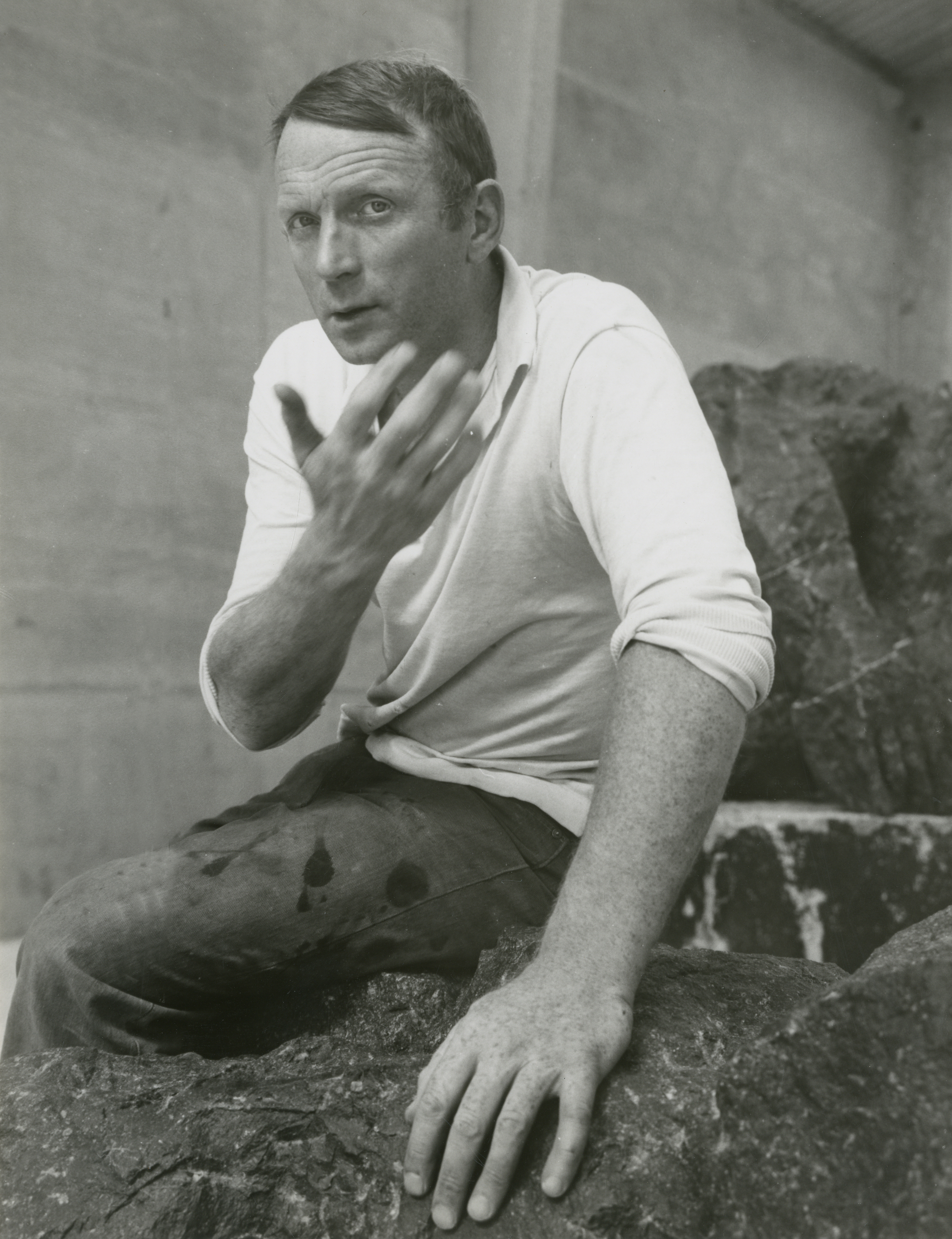
Eugène Dodeigne (1923-2015) was born in Belgium but was not long in becoming a naturalised French citizen when his parents settled in the Nord département. Stonecutting was in his blood – he was heir to a family of stonemasons from the Soignies region, source of stone as beautiful as it was difficult to sculpt. After learning the trade from his stonemason father at the age of 13, predispositions that became evident at the School of Fine Arts in Tourcoing and then in Paris led to his becoming an artist. It was not long before he started receiving support from collectors in northern France. Jean Masurel lodged him in 1948 and Philippe Leclercq became a real benefactor, bringing him in to help with the construction of the Sainte-Thérèse Chapel in Hem among other good deeds. He was represented by the Dujardin and Renar Galleries in Roubaix, but it was the Marcel Evrard Gallery that held his first solo exhibitions in 1952 and 1955.
At the time, the artist worked in wood, creating smooth, rounded shapes, worthy successors to the works of Brancusi and Arp. He met Germaine Richier there, who introduced him into the Paris art scene, resulting in him becoming a regular participant in the May Salon, where he exhibited every year up until 1965. From then on, exhibitions came one after another. His works were presented in Paris. The Claude Bernard, Stone Loeb and Jeanne Bucher Galleries organised major exhibitions for him, showcasing the stones he had been sculpting since 1956 along with the expressionist bronzes he had started creating in 1963. Foreign countries were not far behind, starting with Belgium, the Netherlands and Germany, which populated themselves with his sculptures.
His Soignies stones attained monumental stature in forms wrestled from the matter that depict mankind and the human condition.