11. Planètes
Garden by Momoko Seto
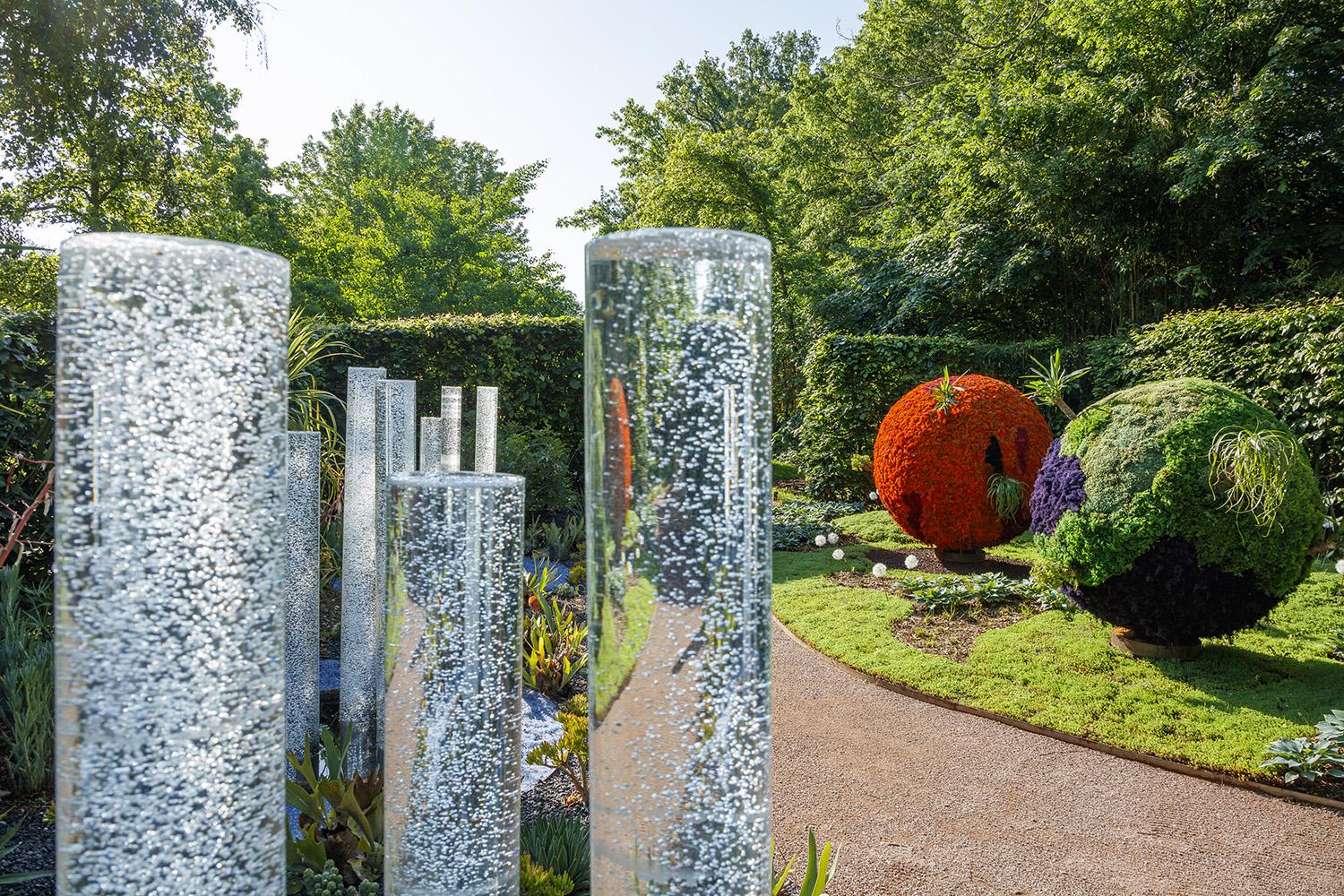
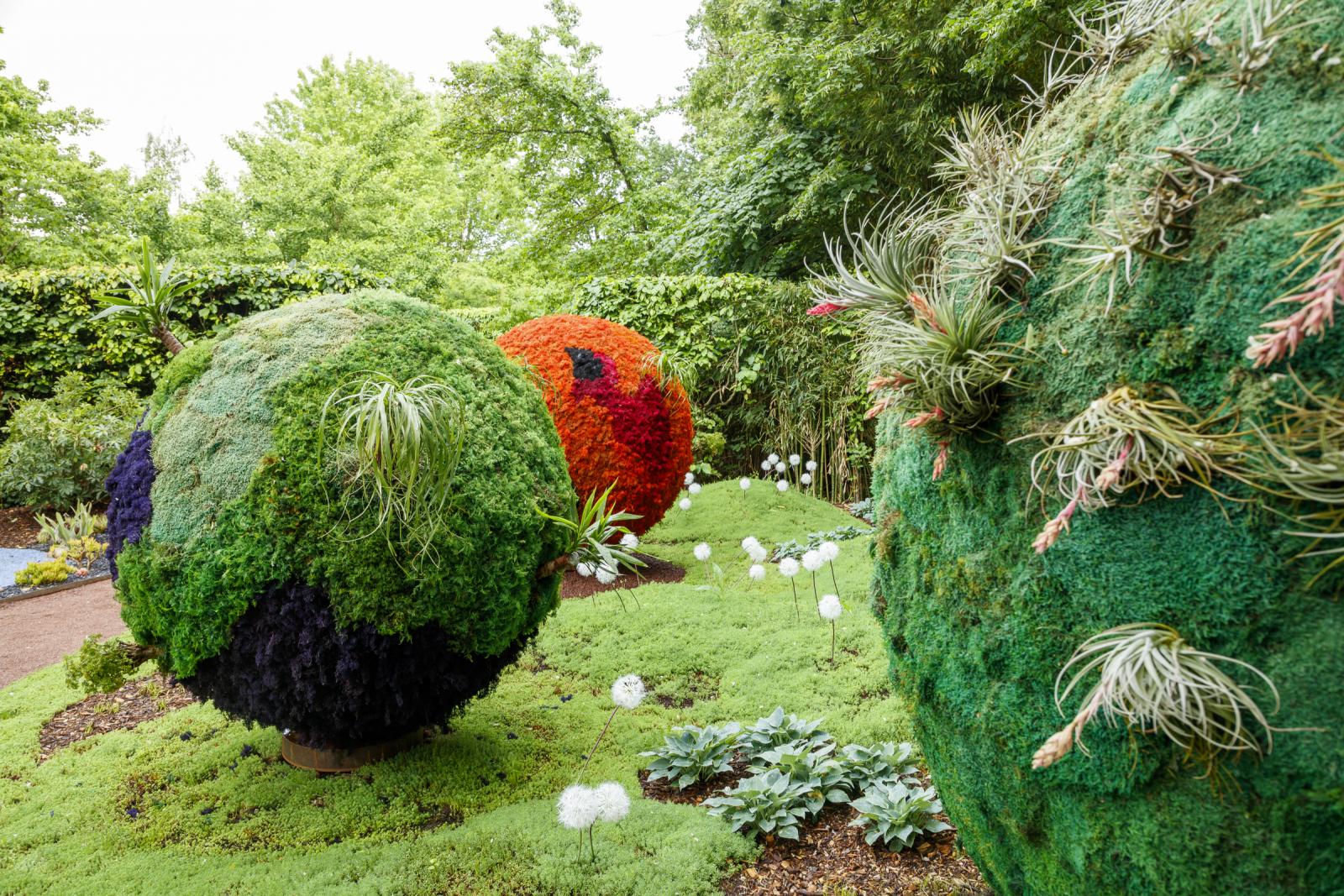
The Japanese artist and filmmaker Momoko Seto invites visitors to a poetic immersion in two dreamlike worlds where nature and cinema interact in harmony. On one side, a cosmic world: three giant kokedama (moss ball) planets spin slowly, like stars in perpetual motion. Each plant sphere embodies a planet with its own characteristics: The first, enveloped in green moss, sprouts yuccas and palms, playing on an imbalance of scale where infinitely small and infinitely large coexist. The second is covered in greenish-blue moss and adorned with roses and flowering plants, evoking the Earth with a nod to The Little Prince’s delicate world. The third, clad in brownish-orange moss, pays tribute to the planet Mars but is crowned with colourful bromeliads symbolising a rebirth of vegetation on its seemingly hostile soil.
Beneath these celestial spheres, a carpet of sedum and Rhynchospora colorata (“white star sedge”) sketches out a miniature galaxy, while balls of synthetic dandelions, suspended in the air, create a poetic mirror between the stars on the ground and the shooting stars frozen in time overhead (dandelions belong to the Aster family and “aster” is the Latin word for “star”).
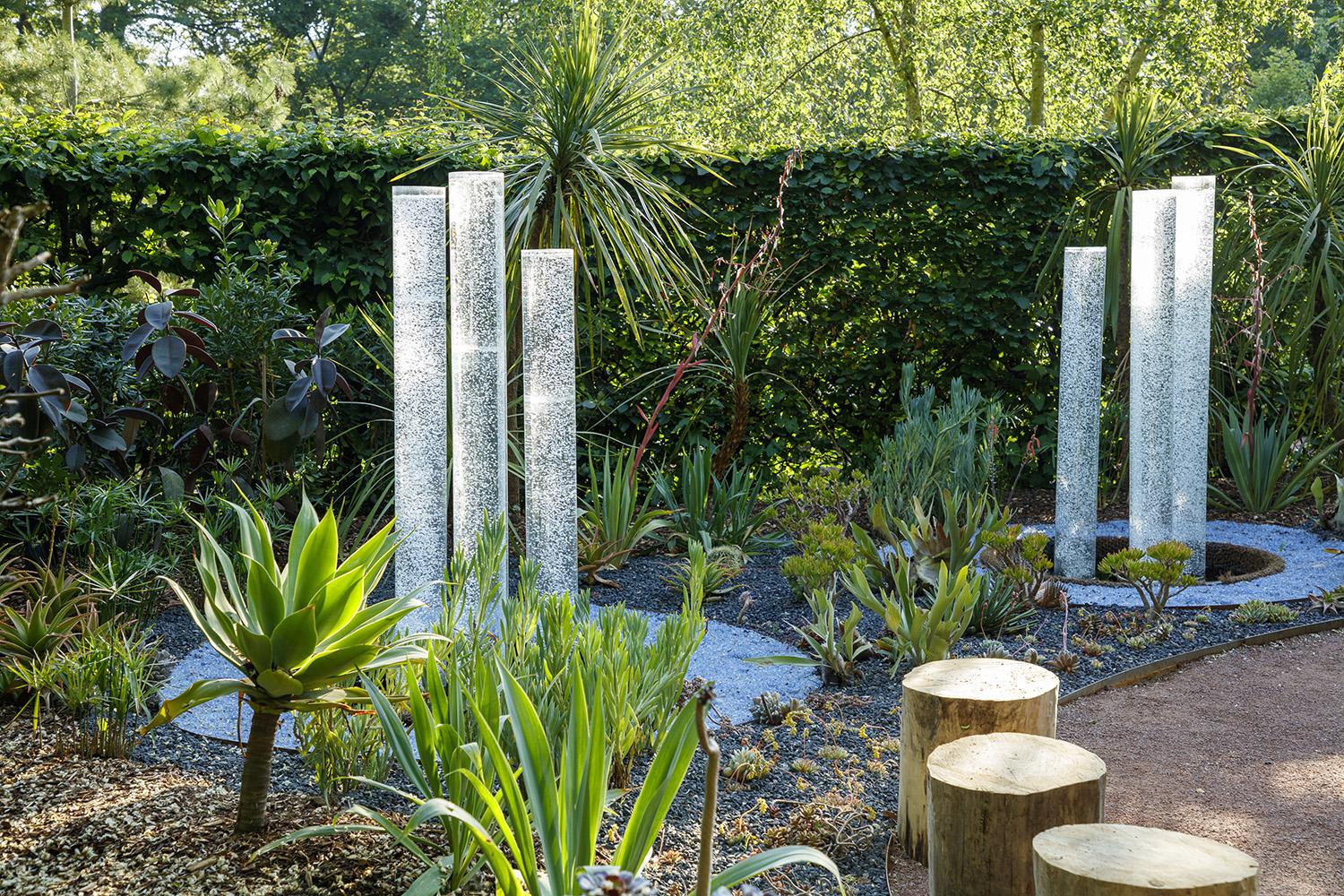
On the other side, a mysterious underwater world: three circular pools harbour transparent tubes in which the roots of emerging plants dance to the rhythm of rising bubbles. Around these liquid mirrors, succulents – Platycerium, Kalanchoe, Senecio and barrel cacti – evoke a stylised deep-sea landscape of seaweed, coral and sea urchins. Visitors are invited to observe the way the landscape is distorted through the columns of water, where spatial and aquatic imaginaries come together, borne by plants that have become the raw materials of these dream worlds.
Momoko Seto, April 2026
DESIGNER
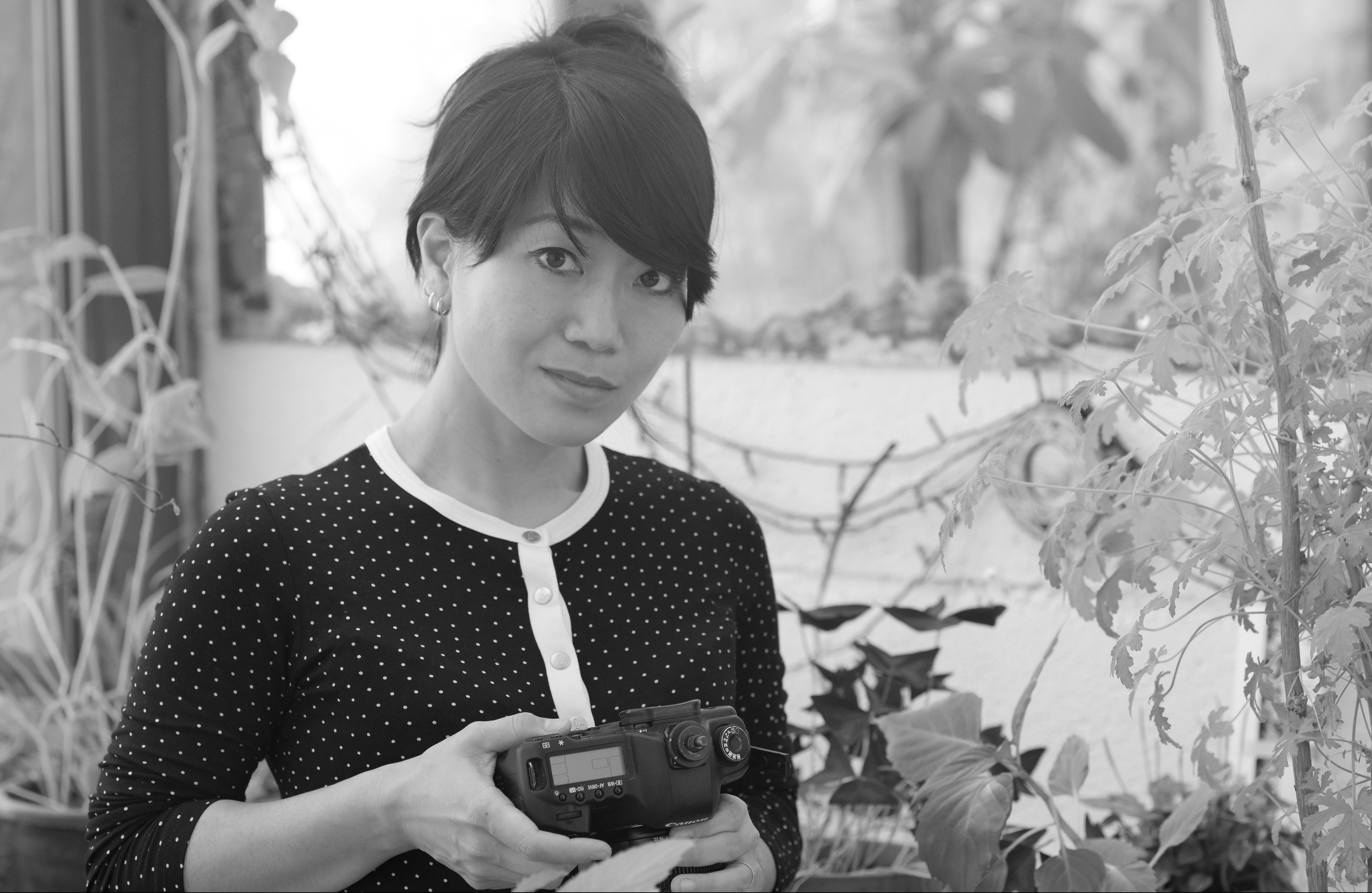
Born in Tokyo in 1980, Momoko Seto grew up in Japan, completing her schooling at Tokyo’s French school. She moved to France at 19 to pursue further studies, initially at the École des Beaux-Arts de Marseille (Marseille School of Fine Arts), then at the Fresnoy – Studio national des arts contemporains, in Tourcoing. In 2006, Seto passed the entrance examination for the Centre national de la recherche scientifique (French National Centre for Scientific Research, CNRS), joining the Réseau Asie-Imasie network as director. Her documentaries profile twenty scientists working in human and social sciences in the Asia-Pacific region. In 2012, she joined the Centre de recherche sur les arts et le langage (Research centre for arts and language, Cral) as a research engineer.
Her visual oeuvre encompasses experimental cinema, scientific documentaries and artistic videos, and she has a keen interest in natural phenomena – mushrooms, slime moulds, seeds, crystals, microorganisms and fungal growth – which she films in fast-forward using the time-lapse technique, and in macro. She has directed a number of short films, including the PLANET series, comprising four shorts (PLANET A – 2008, PLANET Z – 2011, PLANET ∑ – 2014 et PLANET ∞ – 2017). PLANET Σ (pronounced PLANET SYGMA) won the Audi Short Film Award at the Berlinale 2015. It was included in the collection of Tokyo’s prestigious Mori Art Museum, while PLANET A features among the collection at the Cinémathèque Française. In 2017, her PLANET∞ (pronounced PLANET INFINI) virtual-reality film was included in MK2’s catalogue. Momoko Seto has also directed several documentaries broadcast on France TV.
In 2022, she won the Fondation Gan pour le Cinéma’s Prix Spécial for her first full-length feature film, Dandelion’s Odyssey. Entitled Planètes in French, the film was presented during the closing ceremony of Critics’ Week at the 2025 Cannes Film Festival, where it received the Prix de la Critique Internationale (the Fipresci Prize). This environmental and poetic odyssey, filmed in Iceland, Japan and Burgundy, is a fusion of animation, stop motion, time lapse and sound effects created by Nicolas Becker. Just like her short films, this film is similarly devoid of dialogue, instead prioritising imagery and emotion.
This extraordinary journey between art, nature, science and poetry strongly resonates with the philosophy of the International Garden Festival and the Domain of Chaumont-sur-Loire, serving as a tangible incarnation thereof in the garden.
Momoko Seto reminds us that “nature is not a set to be trampled on, that it is not the ‘other’, that all the little things surrounding us are characters in an action film, that a growing plant is so magnificent, it’s enough to make you cry. We are all a force of nature, interlinked with one another, and, collectively, we make up a planet of our own.”