03. Rhapsodie Himalayenne
Himalayan Rhapsody
In Indian folklore, the Himalayas, a mystical mountain range in Asia, are considered to be the sacred realm of the gods, and their backdrop inspires myriad traditional tales. They are often celebrated as the Axis Mundi (world pillar) in Indian writings, as the point connecting Earth to the Heavens.
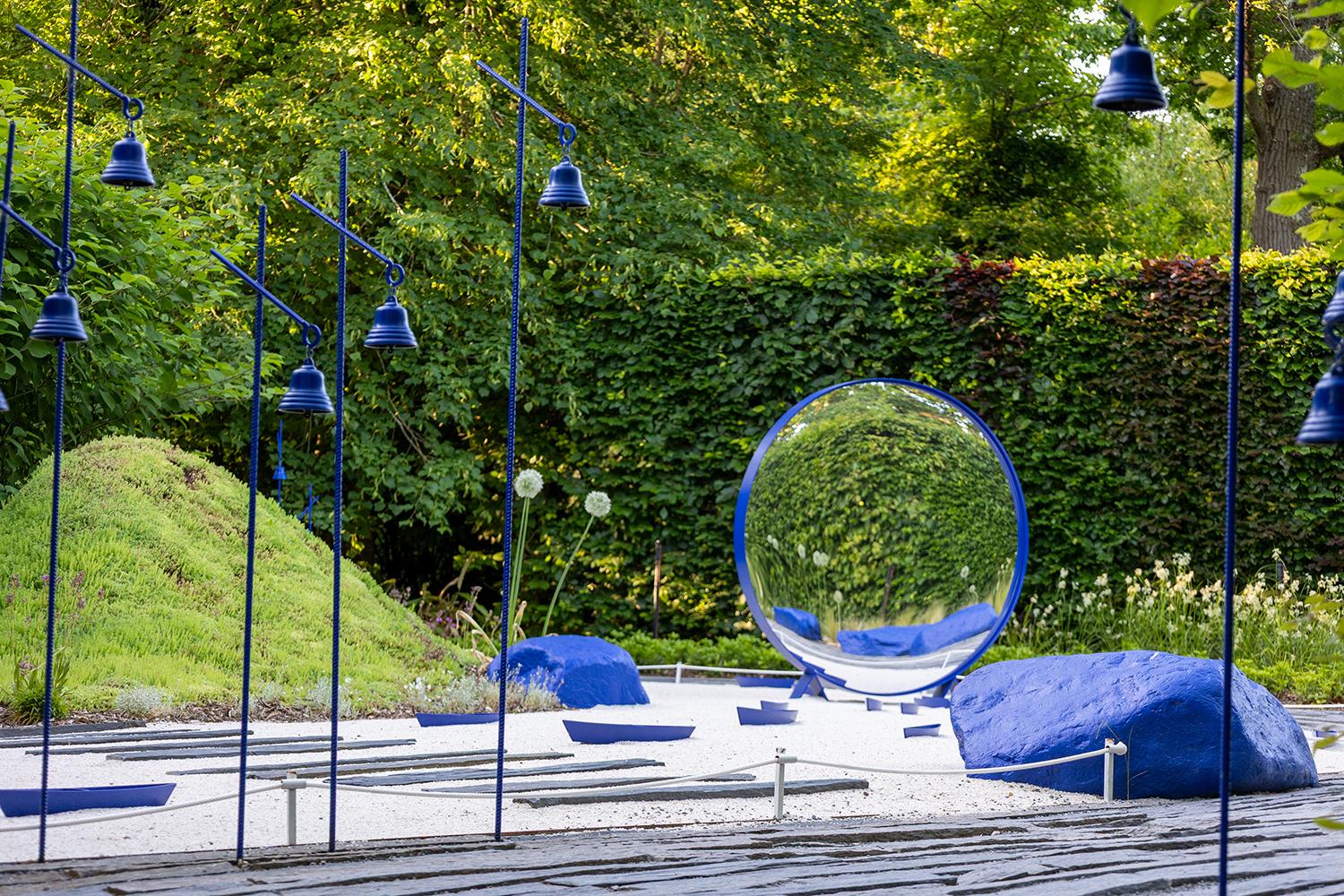
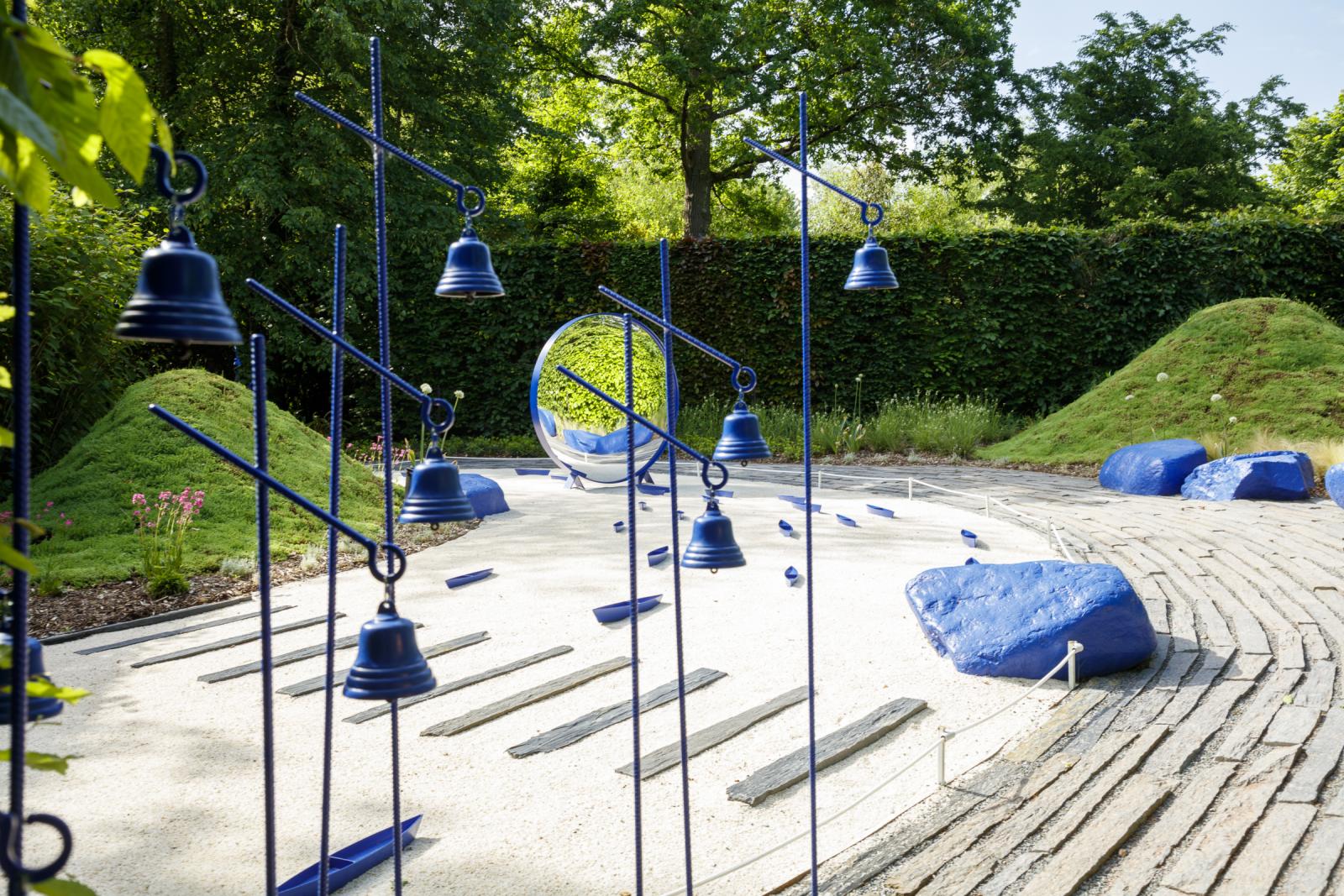
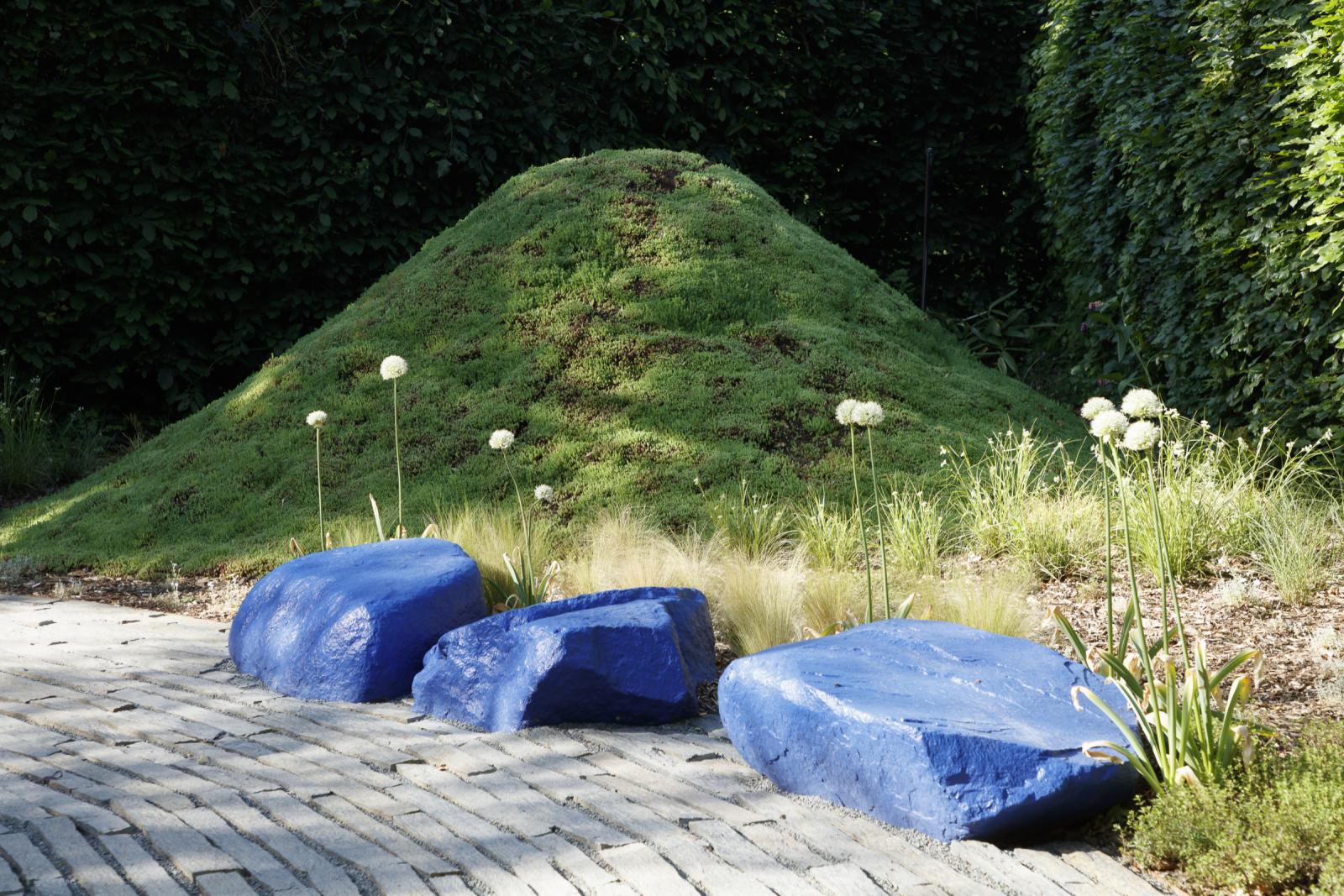
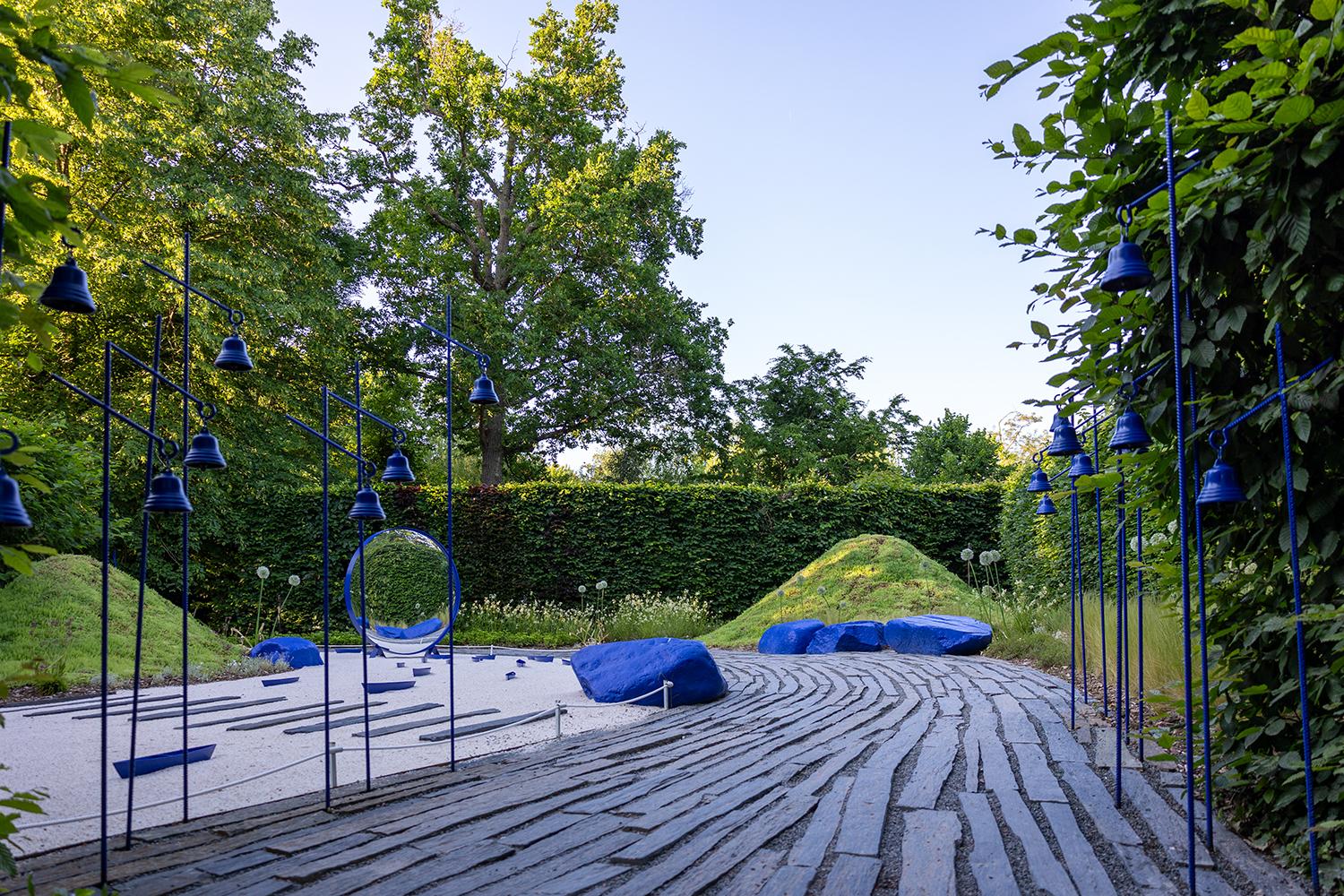
Himalayan Rhapsody is an ode to these majestic mountains and to the intangible cultural heritage they have embodied over the centuries. A powerful glacial river, its bed formed from fine gravel, flows along a path of bare stones between mossy mounds. A series of brass temple bells, hanging from indigo-coloured poles, marks the entrance to this kingdom. Boats, in the same shade of indigo, float on the winding riverbed, towards a large circular mirror. These traditionally crafted boats, an allegory of introspection, each symbolise the journey of someone searching for themselves, as far as the mirror’s reflection on their own life.
A healing landscape takes shape, between the swaying therapeutic grasses and white flowers. It is interspersed with indigo rocks, representing the obstacles in life. The presence of the deity Shiva can be felt, through his three eyes. The colour indigo indicates the inanimate objects. It comes from the Latin word indicum, meaning “Indian”. The dried river is a reminder that the Himalayan glaciers are shrinking because of climate change. Soon, the rivers will die, leaving behind them a bed of gravel, just like this one. As a metaphor of a mystical past, Himalayan Rhapsody also holds up a mirror to the frightening future that awaits the Himalayas.
DESIGNERS

unTAG Architecture & Interiors, is a Mumbai based design studio co-founded by Gauri Satam and Tejesh Patil in 2015. The studio strongly adheres to a climatically sensitive approach with contextual rootedness, focussing on functionality, materiality and economic viability as their core values. unTAG believes in lending its design service to every strata of society, from the affluent to the underpriviledged. The studio has received some prestigious design awards as well as has featured on design platforms like Archdaily, Archello, Domus, etc.
Gauri Satam has graduated from Sir JJ College of Architecture, Mumbai in 2008, and has done her masters in Landscape Architecture from LS Raheja SOA, Mumbai. Gauri has received DIADA Global Thesis Awards 2021 for her Masters. Establishing a connect between humans nature, preferring function over form, spatial experiences over aesthetics are critical to her design sensibilities. She sees Landscape as an integral of their practice, blurring boundaries between built and unbuilt, envisaging a biodiverse environ.
Tejesh Patil has graduated from Sir JJ College of Architecture in 2008. A practising Architect with a 17 years work experience, Tejesh’s expertise lies in designing energy-efficient, environment-conscious and cost-efficient architecture. For Tejesh, sustainability is not just a later addition, but an integral part of design. He strives to integrate native materials alongside passive solar strategies to establish thermal comfort in unTAG’s projects. He strongly believes that an architect’s sensibility can be rightly channelized to tweak the lifestyle of an individual and the society he lives in, so that some day, humans and nature could happily co-exist.
Srivibhu Viraj is an architect and graduate of L.S. Raheja School of Architecture, Mumbai. Vibhu’s thesis” Impermanence in Architecture: A Case of Premabhai Hall’, has won him several national and international accolades. He explored the transient nature of architectural form and the cultural and social forces that shape the built environment. While working at unTAG, Srivibhu has developed a deep interest in landscape design and its profound influence on both people and space.
Maanika Gupta, interning with unTAG, is a fourth–year student at Thakur School Of Architecture, Mumbai. With an enthusiastic persona, her fascination with the Greens serves as a powerful source of inspiration for her creative endeavors.